
One trick Eric
The latest Nigeria squad suggests more of the same against Gabon, but Chelle's recent tactical compromise, though commendable, is barely even skin deep.
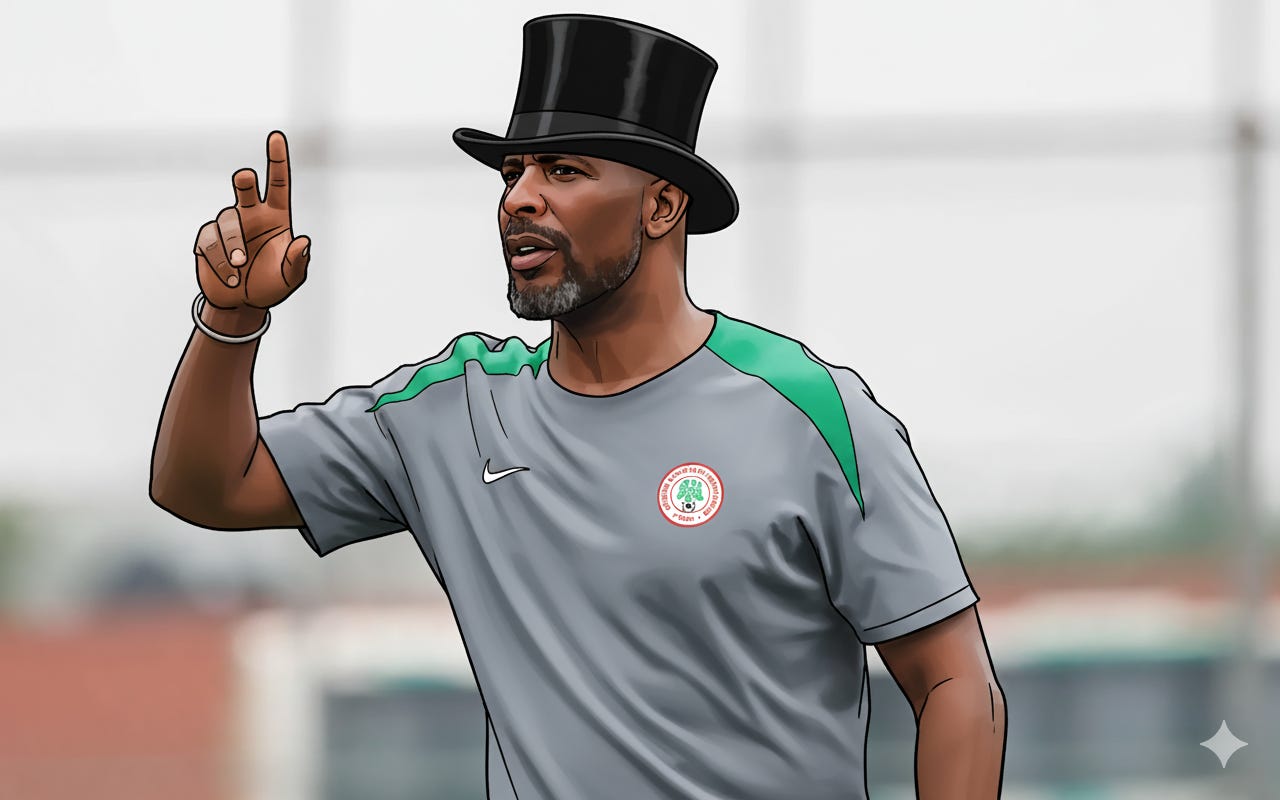
For all the intrigue and coquetry that preceded it, the constitution of the Nigeria squad for next week’s World Cup qualifying play-offs was decidedly predictable. Maduka Okoye’s return to the fold was par for the course, and Chidera Ejuke has been in the orbit of the national team for a while now. (If anything, in the case of the latter, this is arguably the least appropriate time for a recall relative to form, but considering how out of his depth Olakunle Olusegun is, it is difficult to begrudge the Sevilla bit-parter.)
Leaving aside the pivotal nature of the upcoming fixture(s), the implication of an unchanged roster is that Eric Chelle is voting for continuity. If that is the case, it is safe to infer that the Malian is convinced he has found something worth sticking with, and the most recent outings are a useful window on what that is: a pared-back 4-4-2 geared entirely toward leveraging the Super Eagles’ glut in attack.
Considering that cadre includes Victor Osimhen, he of the true elite in the modern game, it is not the worst idea. However, it was not simply their total inability to win without their talisman that derailed the Super Eagles ill-fated first tilt at a place in North America. It was also their failure to hold on, under middling pressure, to an Osimhen-procured advantage against Zimbabwe in Uyo in March. Just as important as plunder is the wherewithal to secure it.
Nigeria seemed to finally hit their stride as an attacking force against Benin, looting their neighbours for four. However, the result, and the salvific quality thereof, hopefully clouded no one’s judgement. The Cheetahs were no doubt well beaten on the day, but they carried a threat throughout, at times even outplaying their hosts. A significant part of that was down to a numerical superiority in midfield, the inherent structural shortcoming of a flat 4-4-2 exacerbated by the selection of an Alex Iwobi-Wilfred Ndidi double pivot: the former wants to play higher, while the latter is not now that same force that once bore up the weight of the world.
All of that is to say that, faced with competent opposition – which it is reasonable to suggest Gabon will provide – the back-to-basics approach that Chelle has stumbled onto a little late in the day might well be exposed. Chelle has made no secret of his desire to pressure the opponent, and while that is fair enough, it is difficult to do so in this system without supreme athleticism in midfield and pace in the backline. As such, the Super Eagles have tried to hold their shape a bit more, but their lack of compactness in a block has sort of exposed that the Malian’s insistence on a high press is not just about ideological preference, but also about capacity: he may simply be unable to coach anything else to a respectable degree.
This is the foible of the modern coach. It was not harped on to this degree in previous times, but managers having a philosophy – a central worldview that undergirds their strategy and emphasis – has always been a thing. What is rather more novel, however, is building their entire ideologies around individual elements of the overall tactical scheme. ‘Pressing’ is not a philosophy by itself (neither is a ‘formation’, necessarily), but a singular detail that can facilitate different philosophies. If a coach is saddled with a group that cannot, for any reason, press, his entire frame should not come crumbling down, nor should he be unable to pivot, at least temporarily, without throwing out everything else.
And yet, increasingly, this is what we see; in Chelle’s case, not only does he want to press, but he only seems comfortable doing so out of a midfield diamond. That is a level of particularity that is constrained by resources, therefore making it mostly unsuited to international football.
His recent compromise, therefore, for all that it can be viewed as commendable, seems more about marking time until he can try for what he really desires. However, away from the likes of Lesotho, Rwanda and Benin, and with the stakes as high as they are, his lack of commitment – emotional and intellectual – to this idea will expose him to far greater jeopardy than at any point previously.