
Commitment
The ongoing impasse between the Super Eagles and the NFF is the perfect avenue to explore an insidious, persistent idea.
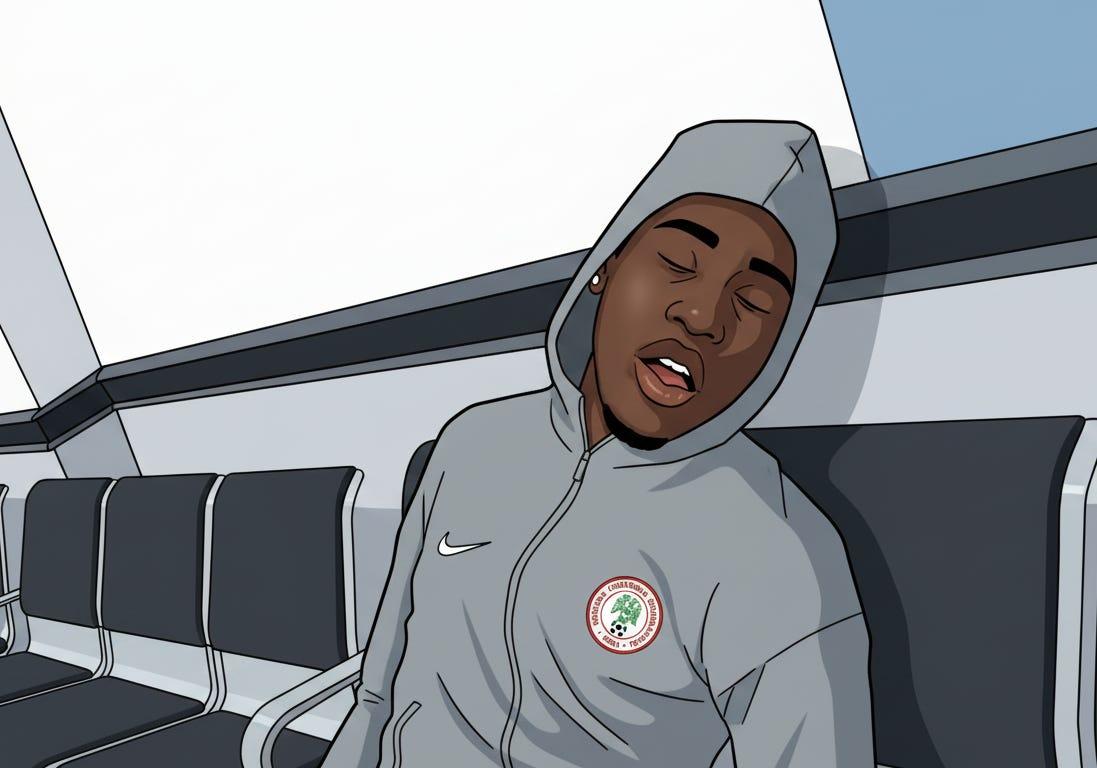
One of my deeper frustrations with much of the discourse, online and offline, by Nigerians as touching Nigerian issues is the pathological inability – or maybe unwillingness – to drill down to the very root of dysfunction. There is an innate lack of curiosity, an intellectual laziness that precludes a thorough examination and rumination of and upon the available data. The upshot of this is that even when, as it is wont to do, time loops back upon itself, there are no new wisdoms to draw upon, and so history simply repeats.
The latest impasse between the Nigeria men’s national team and its hapless Federation over financial infidelity has no doubt been a source of bemusement for observers across the continent and the globe, but in truth it is nothing new. Neither, for that matter, has been the reaction to it, although the public reckoning sparked by the #saveNigerianfootball series of videos by content creator @c_mobike has ensured that, this time, the balance of opinion is tilted in favour of the players. On the other side of the line, however, there has been opposition, mostly of an emotional bent on account of the possibility of missing out on a second successive World Cup, with the timing of the sit-in coming in for particular criticism.
Now, it takes a uniquely cold constitution, the kind of which I am not possessed, to suggest there is a wrong time for a person to demand what he is owed, especially when they have demonstrated a great deal of patience already. However, there is an unmistakable overlap between the people in this camp and those who, over the course of the last five years, have made it their mission to continually question the commitment of the current Super Eagles crop. It is not a stretch, therefore, to infer that their current stance is simply an extension of the pre-existing hang-up: after all, if the players were truly committed to the national team – and to the nation as a whole – would they be willing to jeopardise its chances of reaching next year’s Mundial?
Casting doubt on the investment of individuals in an underperforming team is not a recent phenomenon, of course. While it is tempting to make it about the presence of dual nationals within the Super Eagles, the notion that national team players inevitably become too big for their breeches goes back to the 1980s, when the national team was composed almost entirely of players born and raised within Nigeria’s shores. No, this idea is not of sinister origin; not consciously, at least. Instead, it stems from what was alluded to earlier – a lack of depth applied to thinking about our realities, which leads invariably to faulty conclusions.
In this case, the thinking goes thus: the national team has been posting sub-par results for a while now, even preceding the departure of Gernot Rohr in late 2021, and so since the Super Eagles have cycled through four different head coaches since the German was unceremoniously defenestrated (one of them – Austin Eguavoen – in two separate stints), it stands to reason that the blame for that continued underperformance should fall on the one common denominator: the players.
Leaving aside the obvious caveats – first, winning football matches is not simply a matter of will; second, none of those four coaches, by virtue of their pedigree prior to taking the role, were anything approximating a guarantee of success — this chain of logic fails to take into proper account another common denominator: the Nigeria Football Federation (NFF). Sure, they do not get on the pitch and are not in evidence on the touchline, but there can be no discussion on/about commitment levels in the national team without casting a look at the Glass House.
The narrative is a difficult sell in the first place, not just because, as has been established, the logic is not foolproof, but also because, with all that the players have to weather in order to play for Nigeria, it makes little sense. The owed bonuses, over which their boycott was staged, go back over 30 matches; they have been gaslit over their entitlements, stranded in an abandoned airport in Libya, and endured sundry acts of disrespect that their peers the world over would hardly countenance. In spite of this, fitness permitting (and many have even played through pain for the flag), there is no culture within the current crop of willfully recusing themselves from international duty when the call arrives.
Let us assume, however, that in spite of all of that, the players are indeed not dedicated. The logical next port of call would be to ask why. Has Nigeria somehow managed, entirely by chance, to congregate a group of players who all cannot be bothered to exert themselves in its service. That seems implausible. So, whose job is it to set and define standards of conduct within the national team(s)? Take a few seconds if you must…
Exactly.
Look at it this way: if you have a frequent visitor and wish to have them treat your living room like a sanctuary, you would do well to keep it clean and not make a habit of defecating on the carpet yourself. The NFF can insist till they are blue in the face that playing for your country should be a matter of pride, or they can actually do the work of taking that sentiment from the realm of platitude into reality by running like a professional body and fulfilling their obligations in good time.