
Big Game Blues
Nigeria have a fantastic record in terms of reaching the latter stages of the AFCON, but have tripped at the (semi-)final hurdle one too many times.
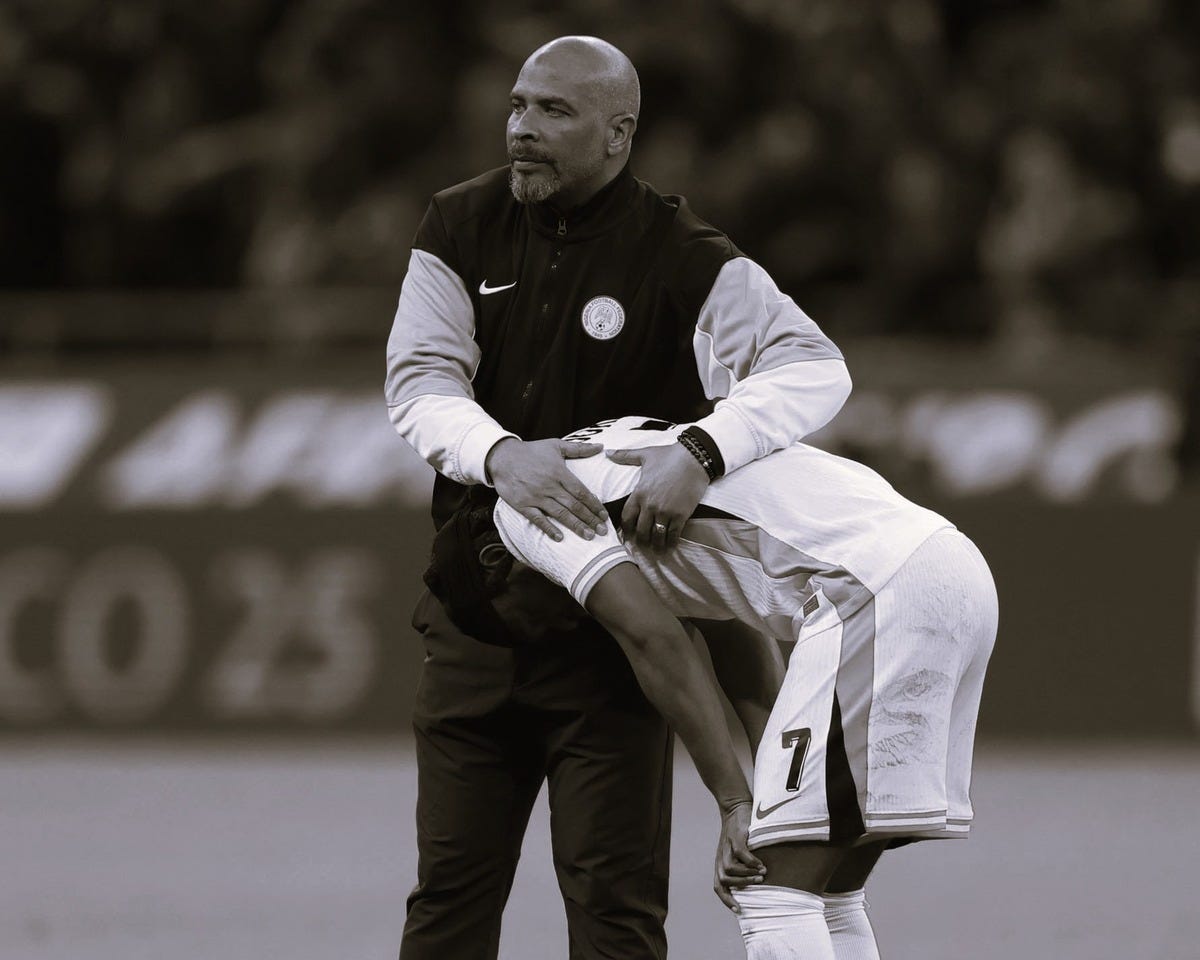
The Africa Cup of Nations is a simple tournament: 8/12/16/24 teams go to war for 2/3/4 weeks, and Nigeria win the Third-Place playoff.
That statement is partly facetious, but with its ninth bronze medal finish, the Super Eagles have practically cornered the market on that particular alloy. Of course, playing in the so-called ‘losers’ final’ at all means progress to the tournament’s final four, and here again the three-time African champions stand uneclipsed, with more semi-final appearances (17) than any other nation bar Egypt, who boast seven AFCON titles.
This disparity in outcomes affirms an uncomfortable reality: Nigeria are poor at winning big matches. If that seems like an extreme read, consider that, even when they have edged their way into the tournament showpiece, they have fallen short more often than not—no nation has lost more finals. Consistency is scant comfort, and to glory in record podium finishes verges on the absurd.
So, what is the reason for this near-success syndrome? It is a thorny matter to scrutinise, as even though commonalities are inevitable, there are enough distinctive circumstances in each individual case. However, in light of how the most recent Super Eagles ouster has been received and parsed, there is one thread that demands pulling. Those who do not learn from history are doomed to repeat it. It is this aphorism, perhaps more than anything else, that is at the heart of Nigeria’s increasingly embarrassing inability to get over the line—in their reluctance to take (the right) lessons from failure, they are trapped in a loop, re-living Groundhog Day again and again.
Elimination at the hands of Morocco, especially in light of the unsavoury denouement to the final, has surprisingly come to be chalked up entirely to the officiating of Daniel Nii Laryea. Now, the Ghanaian indeed was less than stellar, and has even publicly admitted to nerves going into the highest-profile match of his career. Some of his calls were puzzling, the booking of Calvin Bassey being the highlight of an uneven performance that somehow always seemed to be in service of the hosts.
And yet, even acknowledging all of that, the tournament’s leading scorers coming in managed a pitiable two shots in 120 minutes of football, and between them the glittering OLA front three that ripped Mozambique and Algeria to bits only touched the ball in the Moroccan penalty area eight times and only completed only five passes into the final third. That invites contemplation, especially when contrasted with the numbers that Senegal, who themselves had reason to be aggrieved, tallied… unless the implication is that there was more of an incentive for the hosts to cheat in the semi-final than in the final, which would make no sense. Yet it is a conversation not many are willing to entertain, as I found out in the aftermath of my previous newsletter.
This is not a one-off, to be clear. Since 1978, only once—in defeat to Cameroon in the 1984 final—has Nigeria lost by more than one goal in a semi-final or final at the AFCON. With such razor-thin margins, the impact of single events or decisions is greatly exaggerated, and so there remains no end of bellyaching about many of those defeats, the most cited being 1988, 2000 and 2004. There are surely merits to the complaints, but as focus has rested on those perceived injustices, the rest of the nuance of those battles has been laid aside, if it was even engaged with at all.
Should Henry Nwosu’s goal have stood in the 1988 final? Almost certainly. And yet, has much thought been given to the physical superiority of the Cameroonians, or the fact that Nigeria played extra time and penalties in the semi-final against Algeria? Victor Ikpeba’s penalty in the shootout in Lagos clearly was over the line, but few reckon with the fact that Cameroon were the superior side, especially in the first half of the 2000 final. It is not that these grievances are not legitimate, it is the refusal to also critically evaluate every aspect of the defeats as a whole that is often frustrating.
This is an attitude that transcends football, so in a way it is the culture of an entire people. There is rarely an understanding that destiny is a thing to lay hold upon, a ship that demands steering and even, on occasion, course correction. As such, no disaster, no failure is enough to force a reckoning. Nigerian football has moved blithely through missing back-to-back World Cups, through only qualifying for half the AFCON tournaments in the 2010s—both of which should have seen heads on spikes, figuratively speaking—like it was nothing. In light of that, perhaps expecting their football administration to seriously grapple with a comparatively small matter like the country’s appalling big game record at the AFCON is a fools’ errand.
A serious footballing nation would have long undertaken some kind of study in a bid to understand quite what affliction befalls its national team in these crunch ties, why they are so often on the wrong end of things. If the margins are so fine every time, it is clearly not a matter of talent, but of something technical, perhaps even intangible. It also suggests that the required change need not necessarily be seismic or florid. That, though, is provided someone in the Glass House is willing to do the work… or is even convinced there is a work that needs doing.
Solace, between 1989 and 1997 - a period of 8 years we had the trio of Westerhof, Bonfrere and Amodu in charge of the team. Westerhof led the team for 5 years and 3 AFCONs assisted by Bonfrere, when Bonfrere took over the team, Amodu assisted him before he then took charge.
That period, despite the disruption of missing 96 and 98 AFCONs, provided us with a period of high level performance and success that remains a high point of our football.
Between 1997 and 2017, we had 22 different changes of head coach, and at least 14 unique individuals appointed to substantively manage the national team. In the 10 year period between 2000 and 2010 when we solidified AFCON bronze reputation, we changed coaches 11 times.
Between 2010 and 2017 when we failed to qualify for 3 out of 5 AFCONs, we changed coaches 9 times.
If NFF were to ever conduct the type of AFCON forensic study you suggest, one of the primary hypothesis to explore must be the impact of lack of stability of technical crew to success of our senior national teams.
As a parallel, in the 10-year period between 2016 and 2026, Senegal - without an AFCON win at the beginning of the period - have won 2 AFCON titles. Do you want to guess how many times they have changed their coach during this time? Just once.
An intelligent review and comprehensive summary of Nigeria football over the years. Very succinct.
We need some eggheads in the Glasshouse!